No. 8 Revised 4 min read
Completed
Porting the Komodo Mlipir Algorithm to Python
A MATLAB metaheuristic was ported to Python, checked against the original on 23 benchmark functions, and reshaped into a subclassable core so the binary variants could stop copying it.
Contents
Project: Komodo Mlipir Algorithm, Python implementation Period: March 2024, then November 17 - 20, 2026 Repository: github.com/khalilullahalfaath/Komodo-Mlipir-Algorithm
Package kma 0.1.0, requires-python >= 3.10, one runtime dependency (numpy), 582 lines across five modules, 11 tests. The repo starts as a 2024 scaffolding and sits untouched for two and a half years before it becomes the shared core for two papers.
March 25, 2024 Scaffolding
Seven commits in one day, and then nothing until 2026.
- Benchmark function lookup returning bounds, dimension, and known optimum per function id.
- A constructor and population initialization.
- The Python version floor set to 3.10.
November 17, 2026 The port, and the comparison that justified it
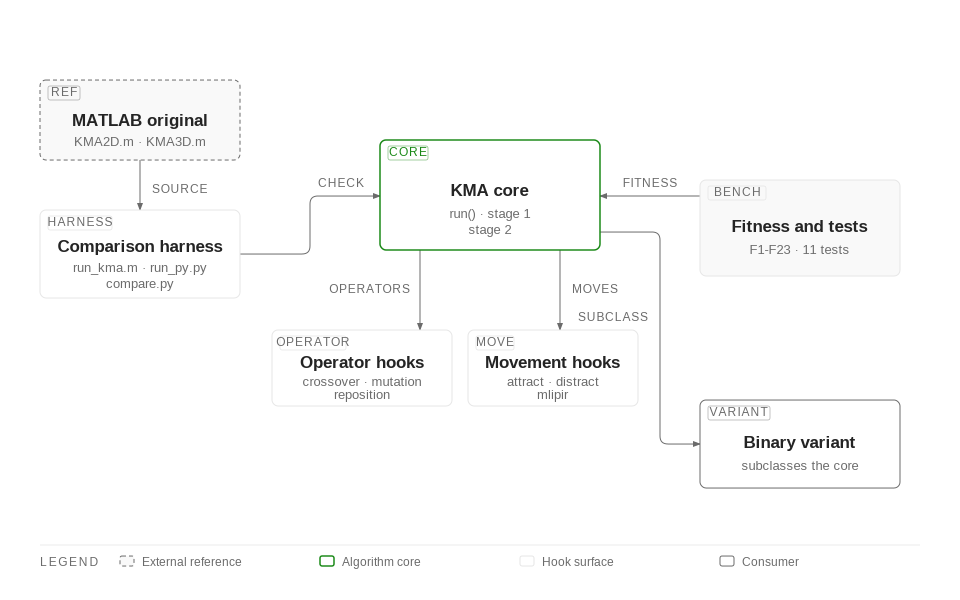
- The main algorithm and all 23 benchmark functions were ported from
KMA2D.m, 645 lines of MATLAB, with the plotting stripped. Fitness evaluation and the two stages were kept as they were. - A comparison harness was built in the same commit series: a script that generates two MATLAB variants from the original folder, a
matlab -batchrunner, a Python runner, a function-value checker, and a comparator. 30 runs per function, dimension 50 for F1 to F13, 25,000 evaluations, MATLAB R2020a. - Two MATLAB variants exist because the original cannot run as shipped.
Evaluation.mlabels Foxholes ascase 16, so F14 errors out and F16 silently becomes Foxholes. That label was changed tocase 14to get a working reference. - The second variant fixes a real bug in
KMA2D.m. The loop over micro-swarms stepsindby the swarm size, 5, but each swarm contributes onlyNumBMrows, 2, soAllHQ(ind:ind+NumBM-1,:)writes into rows 1-2, 6-7, 11-12 and leaves the rows in between as zeros.AllHQis the set of big males the small males follow, so those zero rows become the origin, and the origin becomes an attractor. The Python port indexes correctly. - Function values agree to 5.80e-15 relative difference across 110 points, with F7 excluded because it contains
rand. The port computes the same functions, so the remaining differences come from the search, not from the function evaluation. - Python against the fixed MATLAB: no significant difference on 22 of 23 functions, and F8 at p = 0.022 does not survive correction across 23 tests. Python against the original: significant differences on F7, F8, F12, and F13, all in the original’s favour, all explained by the
AllHQbug. - Evaluation counts match. One deviation: on F9 two of 30 MATLAB runs entered stage two and no Python run did. That is random variation in a branch, not a porting error.
- Wall time per run: Python 2.43 s, fixed MATLAB 3.03 s, original 3.08 s.
- The same commits turn the code into a package with subclass hooks and MATLAB-derived reference tests for the initial population and the initial fitness values.
November 18, 2026 Hooks for the noisy case
num_evawas exposed as an attribute so a fitness hook can read search progresst/Tfrom the first evaluation, which lets the binary variants build time-varying transfer functions without touching the loop.- Stage-two adaptation was given an explicit step (
adaptive_step, default the population size as in MATLAB) and four options for noisy fitness:init_adaptive_size,max_improve,max_stagnan,count_fill_evals, with defaults equal to the MATLAB behaviour. - Stage two in the original grows the population up to 40x and evaluates the newcomers without counting them. That is fine on a smooth benchmark and wrong on a staircase fitness like k-nearest-neighbour accuracy. The options let a caller make that trade explicitly instead of editing the algorithm.
November 20, 2026 Separating the movement steps from the loops
- Four movement steps were extracted as hooks:
_attract,_distract,_mlipir,_sexual. A move accumulates a step over the followed males and returns the new position, so a bit-vector variant overrides the step instead of the loop that calls it. - On the continuous benchmark the change is bit-identical, which is the evidence that it changes nothing.
- The result is a three-layer hook surface. Search-space hooks (
_setup_problem,fitness,trim) adapt the objective. Operator hooks (generate_population,_crossover,_mutation,_add_individual,_reposition) adapt the representation. Movement hooks adapt the step. A binary variant subclasses all three layers and keepsrun().
Where it stands
- Published and used as the core for two papers, one on transfer functions and one on combinatorial problems.
- Open: the second stage is still untested at the budget the papers use, and the comparison harness only covers the continuous benchmark. A binary-space equivalence check does not exist yet, because the binary variant lives in a separate repo.